Devils’ Division

Film Treatment: Devils’ Division
Written by: Joseph C. Jukic
Starring: Mike Jukic, Joe Jukic, Bruno Jukic, Marko Boskovic
Genre: War Drama / Historical Tragedy
Runtime: Approx. 120 minutes

Logline:

Four Croatian brothers join the Devils’ Division—a notorious volunteer unit fighting alongside Nazi Germany on the Eastern Front. As they march into the Russian inferno of Stalingrad, each man confronts his loyalty, morality, and mortality in a war that devours everything.


TITLE MEANING:

“Devils’ Division” refers to the 369th Reinforced Croatian Infantry Regiment, nicknamed the “Devil’s Division” by the Germans. Formed in 1941, it was the only non-German unit to serve under the Wehrmacht’s direct command at Stalingrad.


ACT I: THE PLEDGE

Zagreb, 1941 – The newly formed puppet state of the Independent State of Croatia (NDH) allies with Nazi Germany. Four brothers—Ivan (Mike Jukic), a loyal nationalist; Stipe (Joe Jukic), a quiet poet-turned-soldier; Zvonko (Bruno Jukic), a brutal realist; and Petar (Marko Boskovic), an idealistic Catholic—enlist in the 369th Reinforced Infantry Regiment, eager to fight communism and prove Croatia’s strength.

They are sent to boot camp under harsh German officers and Croatian Ustaše loyalists. There, they meet Captain Schulz, a cold, calculating Wehrmacht officer who sees them as expendable tools.

In a powerful church scene, the brothers swear loyalty to God, Croatia, and the Axis—each with different motivations.


ACT II: INTO THE ABYSS

Summer 1942 – Russia

The Devils’ Division advances through Ukraine, witnessing scorched villages and mass graves. Petar begins to question the morality of their campaign. Stipe writes poems in secret, hiding them in his rifle stock. Ivan remains steadfast, even as Zvonko loots and kills with no remorse.

They cross the Don River into hellfire: the Battle of Stalingrad.

Fighting alongside the German 6th Army, the Croatian unit is sent to Pavlov’s House, Red October factory, and the Volga riverbanks. They are constantly shelled, starved, and surrounded. Frostbite and madness creep in.


ACT III: CRACKS IN THE BROTHERHOOD

As Soviet resistance stiffens, the brothers begin to unravel:

  • Petar saves a Russian child and hides him, violating orders.
  • Zvonko executes a captured partisan woman, fracturing his relationship with Stipe.
  • Ivan receives a letter from home saying the NDH is executing Serbs and Jews in camps like Jasenovac. His patriotic certainty begins to crack.
  • Stipe deserts his post briefly to find a safe place to write. He’s caught and flogged but spared execution when Petar pleads with Captain Schulz.

During a Soviet counterattack, their bunker is overrun. Zvonko sacrifices himself by holding a grenade against an incoming tank. His last words: “We’re not devils—we’re meat.”


ACT IV: FROZEN GRAVES

Winter 1942–1943 – The Encirclement

The German lines collapse. Hitler refuses to let the 6th Army retreat. The Devils’ Division is abandoned—no resupply, no escape.

Petar and Ivan debate desertion. Stipe wants to surrender. Ivan insists they hold the line to the death. A final firefight sees Ivan gunned down, defending a wounded Schulz, still believing in honor.

Petar and Stipe are captured by the Soviets. During a forced march, Petar dies from exhaustion, reciting a prayer as he collapses into the snow.

Stipe, frostbitten and skeletal, survives the gulag. He writes the story of the Devils’ Division on scraps of bark.


EPILOGUE:

Zagreb, 1990s – An old man (Stipe) watches Yugoslavia fall apart again. He sits in a church, holding his lost brothers’ dog tags, now tarnished relics. A young Croatian soldier asks if the story of the Devils’ Division is true.

Stipe replies: “We were devils, yes… but not by nature. By command.”


THEMES:

  • Brotherhood vs ideology: What happens when family loyalty collides with political extremism?
  • Blind patriotism: The cost of following orders under false flags.
  • The dehumanizing nature of war: How men lose their souls in the machinery of history.
  • Faith, guilt, and redemption: Especially for Petar and Stipe, torn between Catholic values and Nazi allegiance.

STYLE & TONE:

A bleak, brutal war film in the spirit of Come and See, Das Boot, and Stalingrad (1993). Realistic handheld combat sequences are contrasted with haunting, quiet moments—frozen prayers, whispered regrets, the sound of wind over snowy corpses. The score blends Croatian folk laments with dirges of distant artillery.


Tagline:

“They marched to Russia with fire in their hearts. Stalingrad turned them to ash.”

Janissary

Film Treatment: Janissary
Written by: Joseph C. Jukic
Starring: Mike Jukic, Joe Jukic, Bruno Jukic, Marko Boskovic
Genre: Historical Epic / War Drama
Running Time: Approx. 120 minutes
Title: Janissary

Logline:

In the final days of the Byzantine Empire, four brothers bound by blood and the oath of the Janissary corps rise through the Ottoman military ranks to lead the decisive siege of Constantinople. Torn between loyalty, destiny, and faith, they must overcome treachery, doubt, and their own haunted pasts to fulfill a prophecy centuries in the making.


ACT I: THE BLOOD OATH

1451 A.D. – Rumelia (European Ottoman Territory)

In a bleak Balkan winter, four boys are taken from their Christian village as part of the Ottoman Devshirme system. The villagers scream, the priest protests, but the boys—Milos (Mike Jukic), Jusuf (Joe Jukic), Branislav (Bruno Jukic), and Markan (Marko Boskovic)—are forced into the ranks of the Sultan’s elite: the Janissaries.

Under brutal training in Edirne, they are stripped of names, of pasts, of faith—and reborn as warriors. Jusuf, the most spiritually conflicted, clings to Christian prayers in secret. Branislav embraces Ottoman culture, becoming a fanatical believer in Sultan Mehmed II’s divine right to rule. Markan excels tactically, and Milos proves himself in hand-to-hand combat.

A Sufi mystic named Sheikh Rumi prophesies that the city of Constantine shall fall not to brute force, but to four brothers of two worlds. Mehmed II hears of the prophecy.


ACT II: THE SIEGE BEGINS

1453 A.D. – Outside the Walls of Constantinople

The brothers, now fully grown and elite commanders, ride at the head of Mehmed II’s vast army—80,000 strong—marching on the heart of Christendom: Constantinople.

Inside the city, Emperor Constantine XI prays as the Greek Orthodox Church fractures between desperation and pride. A Venetian mercenary offers help, but it is too little, too late.

The Janissaries begin building a massive cannon—Basilica—capable of shattering the Theodosian Walls. Jusuf questions the siege, disturbed by dreams of the Virgin Mary and visions of his mother begging him to spare the city. Branislav mocks him: “You pray to a god that lost.”

A secret mission into the city leads to a rooftop meeting between Jusuf and a nun-turned-rebel courier, Sister Theodora, who pleads for peace. He falls in love with her courage.


ACT III: BROTHERHOOD AND BETRAYAL

As the siege intensifies, the cannon fires. The brothers lead charges against the gates, facing Greek fire, arrows, starvation, and doubt. Morale begins to crack.

Markan learns of a betrayal within the Janissary ranks—some Balkan-born converts plan to turn on the Sultan and aid the Christians. The brothers are forced to hunt down their own kin. A brutal night of betrayal ends in bloodshed. Jusuf is torn—he lets some defectors escape.

Branislav reports this to the Sultan, who orders Jusuf’s execution. Milos and Markan intervene. They confront Branislav and accuse him of losing his soul. A violent fight breaks out between the four brothers in the shadow of Hagia Sophia.

Branislav walks away, convinced he is the true “son of Islam.”


ACT IV: THE FINAL ASSAULT

May 29, 1453 – Dawn

Mehmed gives the final order: an all-out assault. The Janissaries march as drums thunder. The brothers fight side by side again, storming the breached walls. Branislav dies holding the Ottoman banner atop a tower, struck down by a Christian knight.

Jusuf finds Theodora dying in the rubble of a church. She begs him to save the children. He leads civilians to safety, even as his comrades pillage the city.

Milos faces a Greek champion in single combat within the Forum. It is a brutal, emotional climax—Milos kills him, but not without wounds.

As the red banner of the Ottomans rises over Constantinople, Mehmed enters Hagia Sophia and declares it a mosque. The prophecy is fulfilled.


EPILOGUE

Years later, Jusuf—now living in seclusion on Mount Athos—writes in a journal. “I was a sword of the Sultan, but my soul belonged to two worlds.”

Milos becomes a general. Markan reforms the Janissary corps from within. The scars remain—but so does the bond of brotherhood.


Themes:

  • Identity and faith: Caught between East and West, Christianity and Islam, duty and conscience.
  • Brotherhood vs ideology: Family ties versus loyalty to empire and belief.
  • The tragedy of conquest: Even righteous warriors leave ruin in their wake.
  • Prophecy and free will: Are we pawns of destiny, or do we choose who we become?

Style and Tone:

A gritty historical epic in the vein of Kingdom of Heaven, Braveheart, and The Last Duel. Visceral battle sequences blend with poetic dream visions and moral introspection. Music mixes Byzantine chants and Ottoman percussion. The camera lingers on weathered faces, smoke rising over domes, and the clash of civilizations.


Tagline: “Brothers by blood. Warriors by oath. Torn by conquest.”
Production Note: Potential for franchise or series: Janissary II – The Balkan Rebellions or The Fall of Vienna.

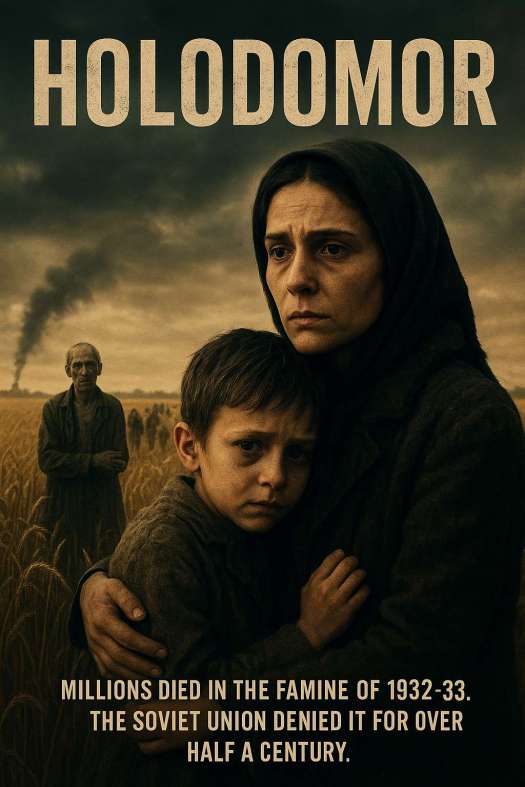
Holodmor Movie

Title: Fields of Ashes

Genre: Historical Drama / Political Thriller

Logline:
In 1933 Ukraine, as Stalin’s regime enforces brutal grain requisitions, a schoolteacher risks everything to save her family and preserve the truth about a man-made famine that will kill millions, while a conflicted Soviet journalist struggles between serving propaganda and exposing genocide.

Synopsis:
The film opens with sweeping shots of Ukraine’s fertile wheat fields—“the breadbasket of Europe.” But as Stalin accelerates collectivization, grain is seized at gunpoint, leaving villages starving.

We follow Nadia, a young widowed schoolteacher in a rural village, who hides scraps of food for her two children while watching her neighbors wither away. Secretly, she keeps a journal documenting the famine, knowing that telling the truth is punishable by death.

Parallel to her story, in Moscow, Dmitri, a Soviet journalist with ambitions of rising in the Party, is assigned to travel to Ukraine and report that collectivization is a success. When he arrives, he confronts the horrific reality—emaciated children, entire villages wiped out, cannibalism whispered in the night. He must choose between loyalty to Stalin and the salvation of his own conscience.

The two storylines intersect when Nadia’s journal is smuggled into Dmitri’s hands. Together, they try to get the truth beyond Soviet borders—risking capture by the NKVD.

Themes:

  • The struggle between truth and propaganda.
  • The resilience of ordinary people against totalitarian cruelty.
  • The moral cost of survival.

Tone & Style:
Think of Schindler’s List and The Pianist—a stark, emotional portrayal of suffering, with brief but powerful moments of human kindness and resistance. Cinematography would contrast golden wheat fields at harvest with the desolation of empty barns and frostbitten corpses in the snow.

Ending:
The film closes with Nadia’s children surviving through Dmitri’s sacrifice, as he is executed for treason. Her journal resurfaces decades later, becoming part of Ukraine’s testimony to the world. A final title card reminds the audience: Millions died in the famine of 1932–33. The Soviet Union denied it for over half a century.