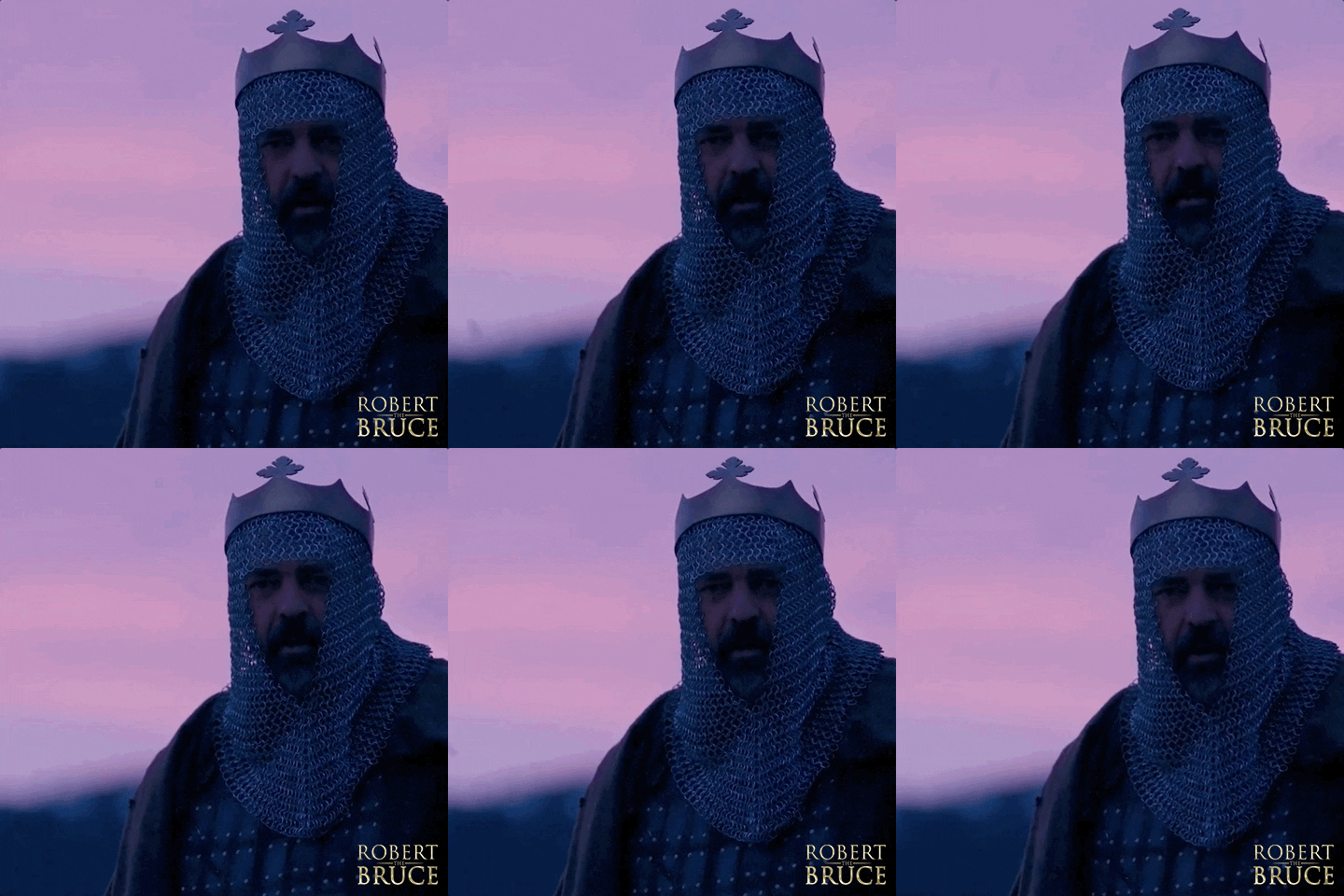
Solid Snake (low, gravelly voice): “They say the second coming isn’t fire and brimstone… it’s one man. One soldier. Standing alone against a Satanic horde. No armies. No governments. No backup. Just him.
Even his own brothers don’t believe. They call him a fool, a madman chasing ghosts. But the truth? Faith isn’t about belief when it’s easy. Faith is standing in the fire when the world calls you insane.
I’ve seen the darkness in men’s hearts. The greed. The cruelty. The hunger for power that turns brother against brother. That’s the true face of the horde. And I know… one man can’t stop it. Not really.
But maybe… just maybe… one man can buy enough time. Enough hope. Enough light… for the rest of us to remember what we’re fighting for.”
(Snake exhales, lights a cigarette, the glow flickering against the shadows.) “One man against hell itself. Sounds like suicide. But hell’s never met me.”
Logline: The brutal fight for Scottish independence fractures the bond between the brilliant but pragmatic King Robert the Bruce and his fiercely loyal but increasingly unhinged younger brother, Edward, forcing them to confront whether the ends of freedom can ever justify their monstrous means.
Tone: A gritty, visceral, and psychological historical drama in the vein of The Outlaw King and The King, focusing on the complex cost of leadership and the corrosive nature of war on family.
Characters:
ROBERT THE BRUCE (CHRIS ARMSTRONG): In his 40s. The King of Scots. A strategic genius and a natural leader, but weighed down by the immense moral and political burden of kingship. He is pragmatic to a fault, often making cold calculations for the greater good. His goal is a stable, independent Scotland, but the path to it is staining his soul.
EDWARD BRUCE (JOE JUKIC): Late 20s/Early 30s. Robert’s younger brother. A formidable, fearless, and terrifyingly effective warrior. His loyalty to Robert and the cause is absolute, but it is fueled by a deep-seated rage and a thirst for glory that borders on the berserk. He is the unleashed id to Robert’s calculating ego.
ELIZABETH DE BURGH (to be cast): Robert’s wife. His emotional anchor and moral compass. Her captivity by the English is a constant source of pain and strategic weakness for Robert.
SIR JAMES DOUGLAS (to be cast): The “Black Douglas.” A loyal lieutenant to Robert. He shares Edward’s ferocity in battle but channels it with more control, serving as a contrast to Edward’s descent.
AYMER DE VALENCE (to be cast): The ruthless English commander, representing the relentless pressure of the opposition.
SYNOPSIS
ACT I: THE FRACTURED CROWN
Opening: 1306. The aftermath of Methven. Robert’s army is shattered, his family and allies captured or killed. He and a handful of survivors, including a bloodied but defiant Edward, flee into the wilderness. This is not a glorious beginning but a desperate, humiliating scramble for survival. We see the core dynamic: Robert is already thinking three moves ahead, despairing at the cost. Edward sees only the insult and burns for immediate, brutal retaliation.
As Robert rebuilds his campaign through guerrilla tactics (showing the famous spider scene not as inspiration, but as a moment of grim perseverance), Edward is his most effective weapon. He takes castles with audacious, reckless assaults that Robert’s more cautious commanders would never attempt. Edward’s bravery is legendary, but Robert begins to see the warning signs: a relish for violence that goes beyond necessity, a contempt for prisoners, a belief that fear is the only true currency.
The central conflict is established: Robert needs to win the peace, to be a king who can rule. Edward only knows how to win the war.
ACT II: THE HAMMER AND THE ANVIL
The stunning victory at Bannockburn is the brothers’ apex. Robert’s masterful strategy sets the trap, and Edward’s ferocious command of a schiltron or the cavalry charge is the hammer that breaks the English army. They are heroes, united in triumph. Scotland is, for the moment, free.
But victory exposes their rift. Robert, now a true king, must court diplomacy. He seeks recognition from the Pope and a lasting treaty with England. Edward sees this as weakness. To him, the enemy is humiliated but not destroyed. He argues for invading England itself, for carving out a kingdom of fire and blood.
Frustrated and sidelined by Robert’s politics, Edward’s violent impulses find a new outlet. He leads punitive raids into England that are so savage—massacring civilians, burning crops to the bedrock—that they become counterproductive, hardening English resistance and embarrassing Robert’s attempts to appear a legitimate sovereign. Their arguments become explosive. Robert is trying to build a nation; Edward is only interested in destroying an enemy.
ACT III: A KINGDOM OF ASH
To channel Edward’s destructive energy away from undermining his diplomacy, Robert makes a fateful decision. He supports Edward’s ambition to open a second front by invading Ireland, to forge a Gaelic alliance and squeeze the English from the west. Robert gives his brother an army and a title: High King of Ireland.
At first, it works. Edward is in his element: conquest. He wins stunning victories against overwhelming odds. But his rule is one of terror. He alienates the very Irish allies he was sent to secure through his brutality and arrogance. Reports filter back to Robert of massacres and impaled bodies lining the roads. Robert is horrified, but he is too far away and too busy securing his own borders to intervene effectively. He is complicit.
The film culminates in the Battle of Faughart (1318). Edward, outnumbered and refusing to wait for reinforcements, charges headlong into the English/Irish army. It’s not a tactical decision; it’s a suicidal act of hubris. He is killed, his body hacked to pieces.
Final Scene: Robert receives the news. There is no grand eulogy. The silence in his council chamber is deafening. He looks not like a king who has lost a troublesome general, but like a brother who has lost his other half—the brutal, monstrous, but undeniably loyal part of himself that he first unleashed and then failed to control. He won his kingdom, but the cost is etched permanently on his face. The final shot is of Robert alone on a cliff, staring out at the sea towards Ireland, the weight of his crown, and his grief, finally and utterly crushing.
KEY THEMES
The Duality of Freedom: Is freedom won through statesmanship or savagery? The film argues it requires both, and that the latter inevitably corrupts the former.
Fraternal Bond vs. National Duty: The intense love and rivalry between brothers, and the tragedy when one’s duty to a nation requires the sacrifice of his brother’s soul and life.
The Cost of Kingship: Robert’s arc is about the terrible loneliness of leadership and the morally compromising decisions required to build something lasting.
VISUAL STYLE
Gritty and Naturalistic: No polished armour. Mud, blood, rain, and the harsh beauty of the Scottish and Irish landscapes.
Intimate Battle Choreography: Focus on the chaotic, personal, and terrifying nature of medieval combat. The camera stays close to Robert and Edward, contrasting Robert’s tactical awareness with Edward’s brutal, efficient killing.
Contrasting Palettes: Scotland is all muted greens, greys, and browns. The Irish campaign is shot with a bleaker, more desaturated palette, reflecting the doomed nature of the enterprise.
Logline: Aging legend Solid Snake is pulled out of retirement for one last, impossible mission: infiltrate the war-torn Himalayas to paint a nuclear missile with a laser target designator to prevent a holy apocalypse, all while wrestling with the philosophies of war, peace, and his own damned soul.
Tone: A philosophical espionage thriller meets gritty, hyper-kinetic action. Think the metaphysical weight of Metal Gear Solid 3 meets the stylish, snappy chaos of a Guy Ritchie film.
Director: Guy Ritchie Starring:
Joseph C. Jukic as Solid Snake
Aishwarya Rai Bachchan as AMMA
ACT I: THE CALL TO DHARMA
OPENING: A montage of global chaos. News clips show border skirmishes between India and Pakistan escalating to a terrifying brink. The catalyst: a charismatic, enigmatic Indian guru known only as AMMA. She preaches a radical, militant Hinduism from a fortified ashram deep in the Kashmir mountains. She claims to be the Goddess Kalki, the final avatar of Vishnu, come to cleanse the world of evil (which, to her, is the entire modern world).
COLONEL CAMPBELL (via Codec, voice grim): “Snake, we’re not facing a nation-state. We’re facing a divine wrath made flesh. Her influence is absolute.”
Snake, older, wearier, but with eyes that have seen too much to ever truly rest, is found in a remote Alaskan cabin. He’s trying to forget. Otacon’s plea is the one he can’t refuse. AMMA has constructed “Vajra,” a monstrous successor to Metal Gear. It’s a mobile launch platform larger and more advanced than anything before, capable of traversing the Himalayan terrain and firing its payload from an impossible-to-pin-down location. She aims to launch a nuclear strike on Islamabad, triggering a full-scale nuclear exchange that will, in her words, “burn the field so a new world may grow.”
The only solution: Operation: Skypoker. A secret US “Rod from God” kinetic weapon system—a tungsten telephone pole dropped from orbit—can destroy the Vajra. But it needs a laser paint on the target for terminal guidance. Snake must get inside the heart of AMMA’s fortress, find the Vajra after it’s been armed and raised for launch, and paint the warhead itself.
As he gears up, Snake mutters to himself, a quote from his dog-eared copy of Marcus Aurelius’s Meditations:
“The object of life is not to be on the side of the majority, but to escape finding oneself in the ranks of the insane.”
THE INFILTRATION: Snake parachutes into the frozen, conflict-ravaged landscape of Kashmir. Ritchie’s direction shines here: freeze-frames introducing packs of mercenaries (The “Kashmir Jackals”), quick-whip pans following Snake’s stealthy movements, and sharp, cynical voiceover from Snake.
He avoids patrols using classic CQC, his body complaining with every move. He quotes Sun Tzu to himself as he plans his route:
“Appear at points which the enemy must hasten to defend; march swiftly to places where you are not expected.”
He witnesses the fanaticism of AMMA’s followers firsthand. They are not just soldiers; they are zealots, believing they are enacting divine will.
ACT II: THE ILLUSION OF MAYA
INSIDE THE ASHRAM: The fortress is a bizarre blend of ancient temple and cutting-edge military tech. Snake navigates prayer halls filled with armed sadhus and server rooms humming with data. He learns AMMA’s backstory through intercepted comms and data files: a figure of immense beauty and intellect, a former quantum physicist disillusioned by global corruption, who weaponized her otherworldly presence to become a living goddess.
He encounters AMMA (Aishwarya Rai Bachchan) herself, addressing her followers via hologram. Rai brings an unparalleled, ethereal intensity to the role—her iconic eyes are both profoundly compassionate and utterly terrifying. She is serenity and annihilation personified. She speaks of the coming fire not with hatred, but with a chilling, maternal pity, her voice a hypnotic blend of softness and steel. She quotes from the Bhagavad Gita:
“Therefore, stand up now, and win glory! Conquer your foes, and enjoy a flourishing kingdom! I have already doomed them to destruction. Be merely the instrument of my work, O Archer.”
Snake, hiding in the shadows, feels a familiar dread. This isn’t about power; it’s about ideology. It’s a ghost he’s fought before. He radios Otacon, his voice heavy, quoting Revelation:
“And the fourth angel poured out his vial upon the sun; and power was given unto him to scorch men with fire.”
THE PAINT: The climax of Act II is a virtuoso stealth sequence. The Vajra is revealed in a massive silo carved into the mountain, being raised to the surface for launch. Snake must navigate the gantries and platforms swarming with technicians and guards. It’s a race against time as the launch countdown begins.
As he finally gets a visual on the gleaming nuclear tip of the missile, he arms the laser designator. A guard spots him. A frantic firefight erupts on the gantry high above the abyss. Ritchie uses slow-motion to highlight the brutal, close-quarters combat, contrasted with the frantic, real-time chaos. Snake is wounded but succeeds, painting the target.
Just as he finishes, AMMA’s voice, calm and clear, echoes through the silo. She’s been aware of him the entire time. She wanted a witness. She confronts him personally, not with soldiers, but with words.
THE BATTLE OF IDEAS: AMMA and Snake have a philosophical standoff. She is celestial and absolute, a vision of divine fury and grace. Snake, battered and bleeding, argues back not with eloquence, but with raw, weary experience. He doesn’t quote scripture at her; he lives it. He is the flawed, enduring soldier, the man who has seen “the end” too many times to believe in it.
He finally responds to her Gita quote with one from Proverbs, his voice a low gravel against her melodic certainty:
“Pride goeth before destruction, and a haughty spirit before a fall.”
For the first time, a flicker of doubt crosses the faces of her inner circle. They see not a demon, but a man—a tired, wounded, yet unbroken man standing against their divine wrath. The seed of mutiny is planted.
ACT III: THE ROD AND THE WRATH
THE KINETIC STRIKE: High above, the Rod from God is released. AMMA, confident in her divinity, continues the launch sequence, believing no man-made weapon can touch her. The scene cuts between the descending rod, the Vajra’s missile preparing to launch, Snake fighting his way out, and AMMA’s followers watching the skies.
The impact is not an explosion, but an act of God. A streak of light, a sound like the sky tearing in half, and the Vajra is simply obliterated from existence, transformed into a crater of molten metal and rock. The shockwave is seismic.
THE MUTINY: The miracle AMMA promised was her survival. Her failure is absolute. Her followers, their faith shattered, see her not as Kalki, but as a mortal woman who nearly doomed them all. The mutiny is swift and brutal. Led by her former most devout disciple, they turn on her. Aishwarya Rai portrays the downfall with tragic, operatic grandeur—the goddess’s mask shatters to reveal a terrifying, vulnerable, and furious woman beneath. She is overthrown not by Snake, but by the very ideology she created.
Snake watches from a ridge as the ashram consumes itself in civil war. He has no more fight left. He quotes King David’s Psalms, a whisper lost in the Himalayan wind:
“The heathen are sunk down in the pit that they made: in the net which they hid is their own foot taken.”
ESCAPE & DENOUEMENT: Wounded and alone, Snake limps through the snow towards the exfiltration point. The geopolitical crisis is averted, but the human cost is immense. In the final scene, he’s on a transport plane, staring at his bloodied hands. Campbell radios, offering a medal, a pension, a thank you from a world that will never know he saved it.
Snake cuts him off. He opens a well-worn copy of Shakespeare, his finger finding a line from Macbeth:
“I have lived long enough: my way of life Is fall’n into the sear, the yellow leaf…”
He closes the book and looks out at the endless mountains below. The mission is over. But the war within him continues. Fade to black.
FINAL LINE (On Screen): “The metal gear was destroyed. The goddess was unmade. But the weapon… was just a man.”